A threaded insert is a small part with a large job: it puts a durable metal thread into a material that cannot hold one on its own. A brass threaded insert is used where a screw must be tightened repeatedly, where the parent material is soft, or where a thread must survive assembly and disassembly without wearing out. The insert itself is simple; the specification is not. A buyer who specifies the insert, the hole, and the installation together gets a joint that holds. A buyer who specifies only the thread size gets a joint that may not.
Where a brass insert earns its place
Brass inserts are used in housings, panels, enclosures and assemblies where the parent material cannot carry a thread. The insert provides the thread, the parent material provides the housing, and the two must work together. Brass is chosen because it machines well, holds a thread, and resists corrosion in ordinary use, and because it can be made in a range of insert forms for different parent materials and loads.
The first question is whether an insert is needed at all. A screw that is tightened once and never removed may not need an insert. A screw that is removed for service, adjusted, or replaced needs one. A buyer who can say how often the screw will be removed, and what load it carries, will get a better recommendation than a buyer who only states the screw size.
Insert types and how they hold
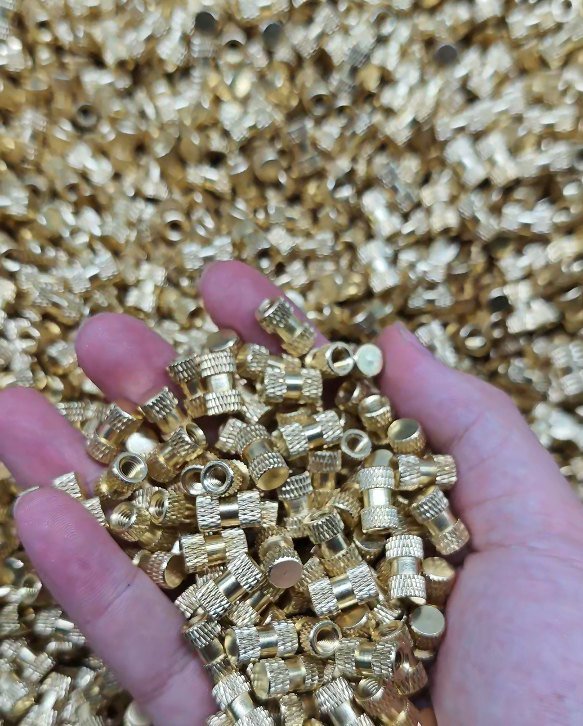
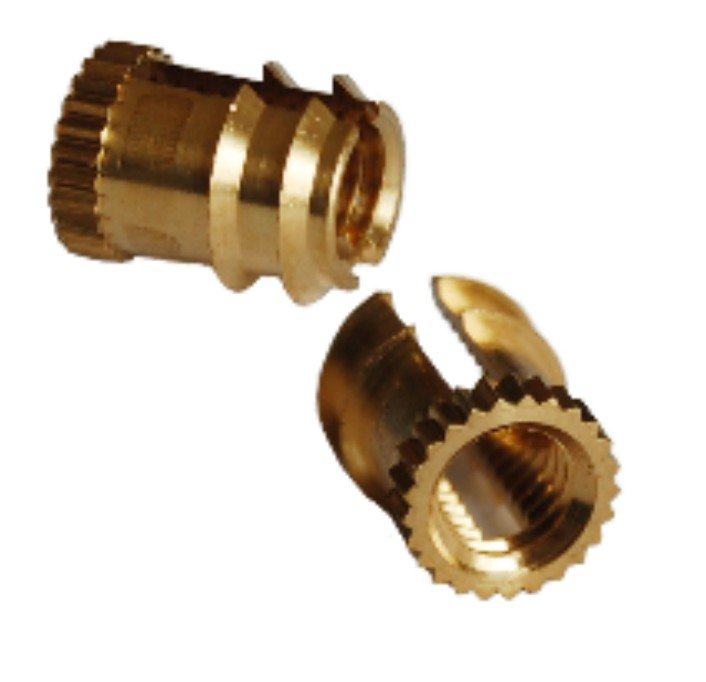
Threaded inserts hold in different ways: some are pressed in, some are screwed in, some are moulded in, and some use a knurled or ribbed outside to grip the parent material. The outside form matters as much as the inside thread, because the outside is what resists pull-out and rotation. A smooth outside will not hold in a soft parent material. A knurled outside grips, but it needs a hole of the right size and a parent material that can accept it.
Do not specify an insert by its thread alone. Specify the insert type, the outside form, the length, and the parent material it will sit in. If you are unsure which type suits the parent material, say what the parent material is and how the joint will be loaded, and ask for a recommendation. An insert that is right for one parent material can be wrong for another.
Thread, hole preparation and the mating screw
The thread inside the insert must match the mating screw, and the hole that receives the insert must match the insert. Both need to be specified. A hole that is too large will not grip the insert; a hole that is too small will crack the parent material or deform the insert. A buyer should state the hole size, the hole depth, and whether the hole is blind or through, and should state the mating screw size and length.
The screw itself matters too. A screw that is too long will bottom out in a blind hole. A screw that is too short will not engage enough thread. State the screw size, the engagement length, and whether the screw will be tightened once or repeatedly. A short note in the RFQ — “screw is removed for service” — changes the insert recommendation.
Installation: the step that is often left out
Installation is part of the specification, not an afterthought. A pressed insert needs a press, a jig, and a controlled force. A screwed insert needs a driver and a hole that will accept it. A moulded insert needs to be placed before the parent material is formed. If the installation method is not stated, the insert may be installed in a way that damages it or the parent material, and the joint will fail in service rather than in the factory.
A buyer should state who installs the insert, what tooling is available, and whether the installation will be done in the factory or in the field. If the insert will be installed by the end user, the installation must be simple and forgiving. If it will be installed in production, the installation can be more controlled, but it still needs to be specified.
Pull-out, torque and vibration: what the joint must survive
A threaded insert fails in three ways: it pulls out, it rotates, or the thread strips. Pull-out is a function of the outside grip and the parent material. Rotation is a function of the outside form and the hole. Thread stripping is a function of the thread engagement and the material. A buyer who describes the load — pull-out, torque, vibration, or a combination — lets the engineer judge whether the insert is adequate.
Vibration deserves special attention. A joint that vibrates needs an insert that resists loosening and rotation, and it needs a screw that will stay tight. State whether the assembly vibrates, whether it is subject to shock, and whether it will be exposed to temperature change. Those conditions affect the insert choice more than the thread size does.
Brass fasteners beyond inserts
Not every threaded fastener is an insert. Brass nuts, studs, standoffs and custom fasteners are turned parts in their own right, and they are specified in the same way: thread, length, outside form, and mating material. A custom fastener is worth specifying when a standard fastener does not fit the space, the load, or the mating part. A buyer who sends a drawing for a custom fastener should state the thread at each end, the length the fastener must hold, and the material it will mate with — the same discipline as for an insert, applied to a different part.
If a fastener and an insert are used together, specify them together. The insert thread and the fastener thread must match, the lengths must work together, and the installation must be possible in the assembled product. A drawing that shows the insert and the fastener in the same assembly is more useful than two separate drawings that do not reference each other.

Common pitfalls and how to avoid them
The most common pitfall is specifying only the thread size and leaving the hole, the insert type, and the installation to guesswork. The second is a hole that is too large or too small for the insert, which is found only when the joint fails. The third is an insert that is too short for the load, or a screw that does not engage enough thread. The fourth is an insert chosen for one parent material and used in another, where the outside grip does not hold. The fifth is an installation method that damages the insert or the parent material because it was never specified. The sixth is a joint that vibrates, where the insert was specified as if the load were static.
Buyer checklist
- State whether the screw is tightened once or removed repeatedly for service.
- Name the parent material the insert will sit in.
- Specify the insert type and outside form, not just the thread size.
- State the hole size, depth, and whether it is blind or through.
- State the mating screw size, length, and thread engagement.
- Describe the load: pull-out, torque, vibration, or shock.
- State who installs the insert and what tooling is available.
- If an insert and a fastener are used together, show them in the same assembly drawing.
Request an engineering quote for custom brass threaded inserts or fasteners and send the drawing with the insert type, hole and mating screw stated at https://precimora.com/request-a-quote/ — the quote is promised in 24–48h.